Updated October 9, 2026. If you are flying to Milan, it is worth knowing that the European Union has published new air passenger rights rules: Regulation (EU) 2026/2202 rewrites the 2004 rules more than twenty years later. The most important point for travelers is easy to understand: the three-hour delay rule remains the main reference for compensation in many cases.
This matters if you are flying to Milan Malpensa, Milan Linate or Bergamo Orio al Serio. A delayed flight can affect your hotel check-in, train connection, car rental, business meeting, private transfer or onward trip to Lake Como, Turin, Verona, Venice, Florence or Switzerland.
The reform is now law: the regulation was published in the Official Journal of the European Union on October 2, 2026, and enters into force on October 22, 2026. That does not mean you can use it yet: the text itself says it applies from October 23, 2027. Until then, the current rules still apply, and they are the ones explained below.
Table of Contents
Flight delays: the three hours count at arrival
The key detail is not when your flight leaves, but when you actually arrive. If you reach your final destination three hours or more after the scheduled arrival time, you may have the right to compensation.
This means you should always check the real arrival time, not only the departure delay. A flight can leave very late but recover part of the time in the air. It can also leave with a smaller delay and arrive much later because of traffic, airport congestion or other operational problems.
For travelers, the practical rule is simple: check your scheduled arrival time, then compare it with the time the aircraft actually arrived at the final destination.
How much compensation can you receive?
The amount depends on the distance of the flight. It does not depend on how much you paid for the ticket.
Even a low-cost ticket may give you the right to compensation if the conditions are met.
| Type of flight | Compensation |
|---|---|
| Flights of less than 1,500 km | €250 |
| Flights between 1,500 km and 3,500 km | €400 |
| Flights above 3,500 km | €600 |
For many flights to Milan from other European cities, the most common cases are the first two categories. Long-haul flights to Milan Malpensa may fall into the highest category, depending on the route.
One detail: for flights within the EU, the amount is €400 for anything over 1,500 km, even beyond 3,500 km. The €600 level is for longer flights to or from outside the EU, according to the official EU guide to air passenger rights. On these long flights, if you arrive between three and four hours late, the airline may cut the compensation by half, according to the European Commission’s official guidelines on the regulation (point 4.4.9), based on a 2009 ruling by the EU Court of Justice. It is an option, not an obligation: many airlines still pay the full €600.
The new regulation keeps the three-hour threshold and the same amounts.
The exact answer always depends on the flight, the airline operating the route, the length of the delay and the reason for the disruption.
What changes with the new EU regulation from October 2027
In June 2026 the European Commission announced a political agreement on revised air passenger rights, the European Parliament approved the final text on July 7, and Regulation (EU) 2026/2202 was published in the Official Journal on October 2, 2026. Everything below only applies from October 23, 2027.
For travelers, the most useful changes are these:
- Same three hours and same amounts: compensation is still €250, €400 or €600 depending on distance, if you reach your final destination more than three hours late. The option to halve the €600 amount when the arrival delay is under four hours remains: the regulation simply writes into law what EU case law has allowed since 2009.
- Information within 96 hours: when you are entitled to compensation, the airline must send you, electronically and within 96 hours after the end of your journey, information about that right and clear instructions on how to claim it.
- Deadlines to claim and to pay: you will have nine months from the flight date to claim. The airline must acknowledge your claim immediately and, within 30 days, either pay or explain why it refuses. Payment is by bank transfer; vouchers or other forms only if you explicitly agree.
- An official list of extraordinary circumstances: the regulation includes a non-exhaustive list of events that can exempt the airline, which must prove the direct link between the event and the disruption. If it refuses to pay, it has to say which circumstance it relies on and why.
- Automatic refunds within seven days: if you choose a refund, it must be paid within seven calendar days by bank transfer (up to 30 days if the airport activates its contingency plan).
- Rerouting, even with another airline: to get you to your destination as soon as possible, the airline must offer, depending on availability, at least one alternative, such as a different route, another airport (with the transfer paid by the airline), a flight with another airline or, where the distance allows, another means of transport.
- Missed connections: if you miss a connection on the same booking because of the previous flight, the airline operating that previous flight handles rerouting and assistance. If it cannot reroute you within five hours, it must also offer a refund.
- More detailed assistance: a snack every two hours of waiting, a meal after three hours and then every five hours (up to three a day), internet access and two phone calls, plus a hotel and transfers if you need to stay overnight. In extraordinary circumstances, the hotel can be limited to three nights. If the airline offers nothing, you can arrange it yourself and claim reasonable expenses back, to be refunded within 14 days. EU airports will also have to provide free drinking water and phone charging points.
- Stuck on the tarmac: if the aircraft sits on the tarmac for two hours at an EU airport, it must return to the gate so passengers can get off, unless safety, immigration or air traffic control reasons prevent it. During the wait, the airline must ensure heating or cooling, access to toilets and, where possible, free drinking water.
- Free name corrections: spelling mistakes in your name must be corrected free of charge at least once, if you ask at least 48 hours before departure.
- Printed boarding passes: airlines cannot deny boarding or charge you for using your own printout of a digital boarding pass, nor charge for printing it once you have checked in.
- No more no-show penalties on return flights and better protection for passengers with reduced mobility or disabilities (see below).
This is important because many passengers do not claim compensation simply because the process is confusing. They do not know which form to use, where to send the request or what the airline is required to explain.
What to do at the airport if your flight is delayed
If your flight to Milan is delayed, do not throw anything away. You do not need to become an expert in EU law while you are waiting at the airport. You just need proof.
- Keep your boarding pass and booking confirmation.
- Take screenshots of airline messages, app notifications and airport departure boards.
- Keep receipts for meals, drinks, hotel stays or transfers paid during the delay.
- Write down the actual arrival time at your final destination.
- Ask the airline for written information about the reason for the delay.
- File the first claim directly with the airline, using the official form or procedure indicated by the carrier.
If the airline does not provide assistance and you have to pay for necessary and reasonable expenses, such as food or accommodation during a long wait, your receipts may help when asking for reimbursement.
Why this matters when flying to Milan
In Milan, the flight is often only the first part of the trip.
Many travelers land at the airport and then continue by train, bus, taxi, private transfer or rental car. Others arrive for a trade fair, a concert, a fashion event, a football match, a business appointment or a connection to another city.
A late arrival can create problems very quickly. You may miss the last train, arrive after hotel reception hours, lose your car rental booking or need to pay for a more expensive taxi.
Compensation can help later, but it does not solve the immediate problem when you are at the airport with luggage and no easy connection.
That is why it is better not to plan tight connections right after landing.
Malpensa, Linate and Bergamo: check your next connection
Milan has three airports commonly used by travelers visiting the city.
Milan Malpensa is the main intercontinental airport. It is located northwest of Milan and receives many long-haul flights, as well as several European routes.
Read also: Getting from Malpensa Airport to Milan Center
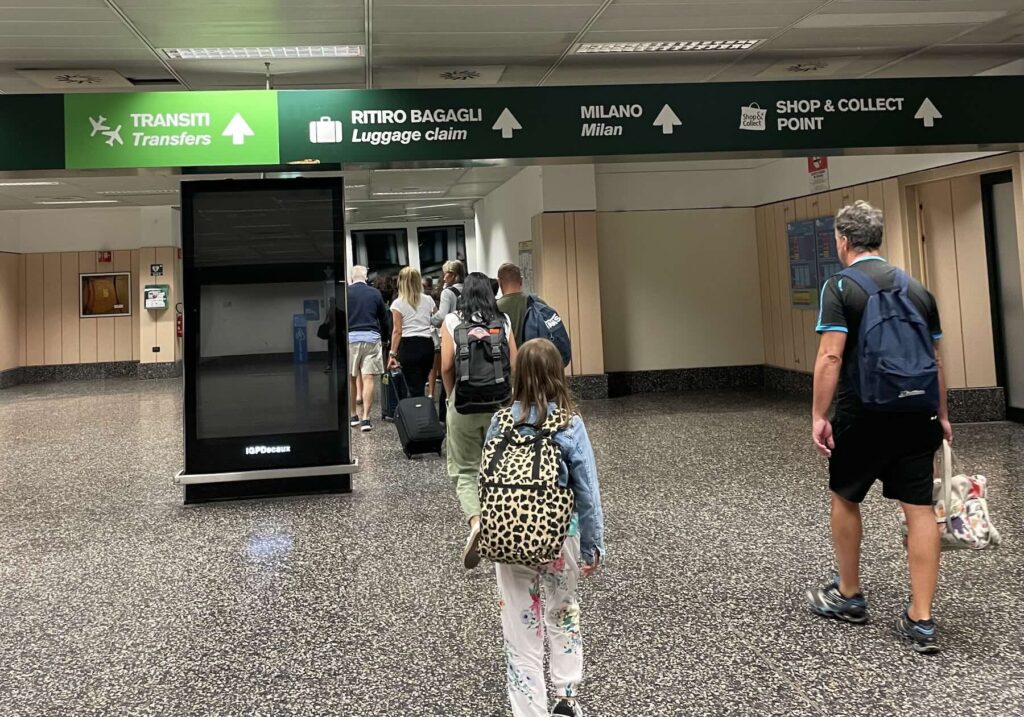
Milan Linate is closer to the city center and can be very convenient for domestic and European flights.
Read also: Best Ways to Get from Linate Airport to Milan City Center
Bergamo Orio al Serio is not in Milan, but many travelers use it when visiting Milan, especially on low-cost routes.
This makes planning important. If you land at Malpensa, you may still need a train or bus to reach Milan. If you land at Bergamo, the transfer takes longer and can depend on traffic. If you land at Linate, the airport is closer, but a late arrival can still affect your hotel check-in or next appointment.
Before booking, check not only the ticket price, but also the arrival time and the transfer options available after landing.
This is especially important if you arrive late at night, travel with children, carry several bags or plan to continue to another city on the same day.
Hand luggage and ticket prices: more transparency
The new EU regulation also deals with fare transparency and hand luggage.
This is very practical for travelers booking low-cost flights to Milan. Sometimes the price shown at the beginning of the booking process is not the final price. The total can increase when you add a cabin trolley, seat selection, priority boarding or other services.
The final text does not make cabin trolleys free: airlines can still sell fares without hand luggage. What changes is transparency: from October 23, 2027, fares including hand luggage must be shown by default before the booking process starts, so it becomes easier to compare prices across airlines and booking platforms.
For now, the safest advice is simple: before paying, check exactly what the fare includes.
A small personal item is not always the same as a cabin trolley.
No-show policy: what changes for return flights
Another important change is the ban on no-show policies for return flights.
From October 23, 2027, if you do not take the outbound flight on the same booking, the airline cannot deny you boarding on the return flight for that reason, and it cannot charge you anything for it either.
This can be useful in real travel situations. For example, you may miss the first flight because of a train delay, a health problem or another unexpected issue, but still want to use the return flight.
Under the revised rules, the return flight is no longer lost just because you missed the outbound journey.
Until then, the old rule still applies. The official EU guide still lists a missed outbound flight on a booking that includes the return as a reason an airline may deny you boarding. If you have to skip the first flight, contact the airline before the return and check its conditions.
Passengers with reduced mobility
The revised rules also improve protection for passengers with reduced mobility or disabilities.
The European Commission says these passengers should receive better support during travel disruptions. Essential mobility equipment should also be better protected.
This is not a small detail. If a wheelchair or other mobility equipment is damaged, the passenger may lose independence during the trip.
The official information also says that people with reduced mobility or disabilities can receive the full cost of their mobility equipment if it is damaged.
Before flying to Milan: practical advice
Compensation is useful, but good planning is still the best protection.
Before booking a flight to Milan, check the arrival time, the airport and the last connections to your final destination. If you need a train, car rental, hotel check-in or private transfer, leave enough time between one step and the next.
This is even more important during busy periods in Milan, such as Milan Design Week, Fashion Week, major concerts, football matches and trade fairs.
During these dates, hotels and transfers can be more expensive. Last-minute changes may also be harder to manage.
The practical lesson is simple: know your rights, keep your documents and avoid planning connections that are too tight.
Where to check before filing a claim
Before relying on forums or incomplete information, start with official sources.
The full text of the new rules is Regulation (EU) 2026/2202 on EUR-Lex, the EU’s official law database. Remember that it only applies from October 23, 2027.
The Your Europe air passenger rights guide explains the current EU rules.
ENAC, the Italian Civil Aviation Authority, provides information for passengers traveling from or to Italy.
The airline that operated the flight should be the first place where you file a claim. Use the airline’s official form or complaint procedure.
If the airline does not answer properly or refuses the request without a clear reason, you can then check the national enforcement authority for the country involved.
For travelers flying to Milan, the best approach is practical: check your flight status, keep your documents, save your receipts and ask the airline for clear instructions.
Enjoyed the tip? When you book or buy through our links, you support Milan.Tips at no extra cost to you.
FIND YOUR NEXT STAY
Book your stay in Italy or anywhere in the world with our partner Booking.com!
You'll find the best deals and support our website. Thank you!
BOOK TRANSFERS AND TOURS ONLINE
Book transfers, tours, and excursions in Italy and around the world with our partner Get Your Guide.